For planning, Google Search Ads in India can range from ₹20–₹150 per click. The supplied industry CPL ranges span ₹150 to ₹4,000, with different conversion definitions and audiences. Your actual cost depends on the auction, location, ad relevance and conversion rate.
How to read this guide. Cost tables are author-supplied directional benchmarks, not Google rate cards, audited national averages or guaranteed outcomes. The supplied images use slightly different summary bands from some tables; each caption explains the comparison. Distinguish enquiries, qualified leads and customers before comparing CPL.
Everyone Googles "Google Ads cost in India" before spending their first rupee. And every answer they find says the same thing: "it depends."
That's technically true. And completely useless.
After managing ₹8 Cr+ in ad spend across Google, Meta, and LinkedIn; and generating 2,500+ qualified leads for clients in real estate, education, healthcare, SaaS, and e-commerce; I can give you practical planning ranges for Google Ads costs in India in 2026.
The guide covers costs by industry, ad format and city tier, plus budget frameworks and ways to diagnose relevance problems. These are directional benchmarks, not a Google rate card or guaranteed campaign results.
Let's get into it.
View the benchmark guide artwork
Quick Answer: What Does Google Ads Cost in India in 2026?
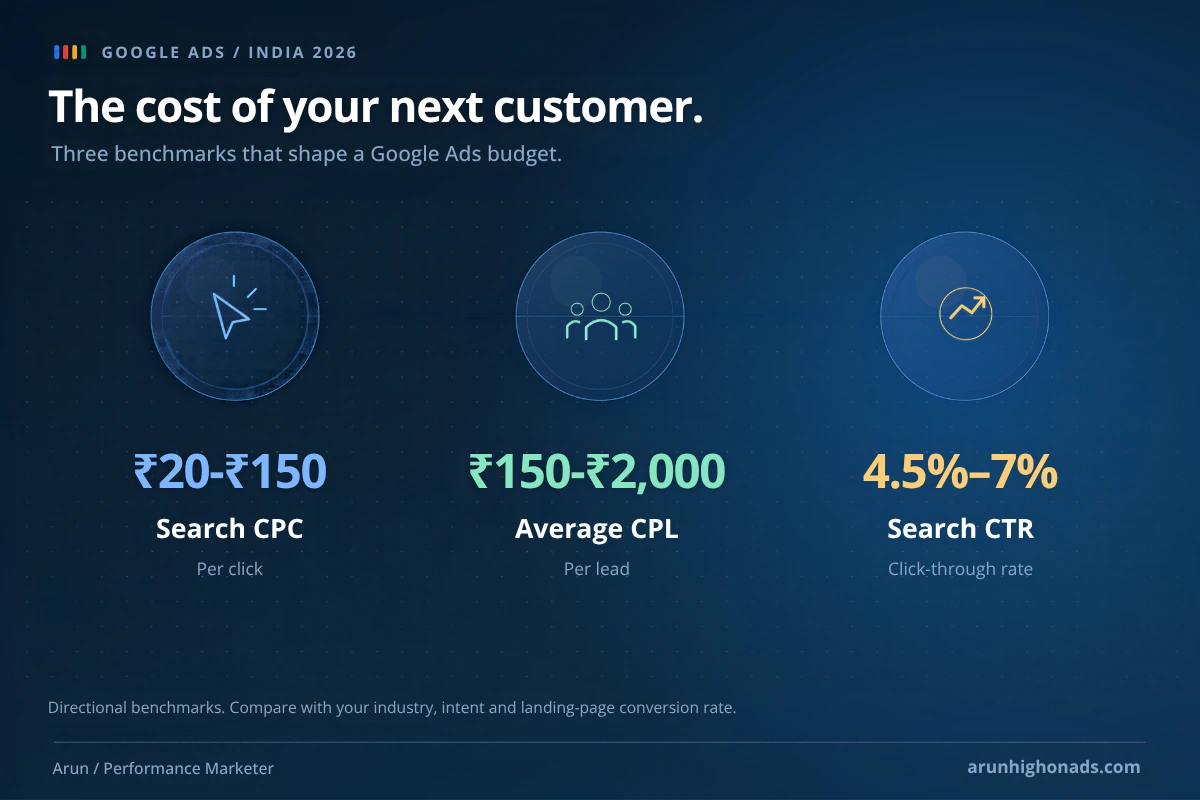
Before the deep dive, here's the snapshot:
| Metric | India Average (2026) |
|---|---|
| Search Ads CPC | ₹20–₹150 |
| Display Ads CPC | ~₹5 |
| Display Ads CPM | ~₹50 |
| YouTube Ads | ₹1–₹10 per view |
| Shopping Ads CPC | ₹5–₹15 |
| Average Search CTR | 4.5%–7% |
| Average CPL | ₹200–₹2,000+ (varies by industry) |
| GST on Ad Spend | 18% (check billing entity and invoice) |
That ₹20–₹150 CPC range is real, but the number that matters is your Cost Per Lead, not your Cost Per Click. A ₹100 CPC that converts at 15% gives you a ₹667 CPL. A ₹20 CPC that converts at 2% gives you a ₹1,000 CPL.
The cheap click is more expensive. Keep reading.
Google Ads CPC by Industry in India (2026 Benchmarks)
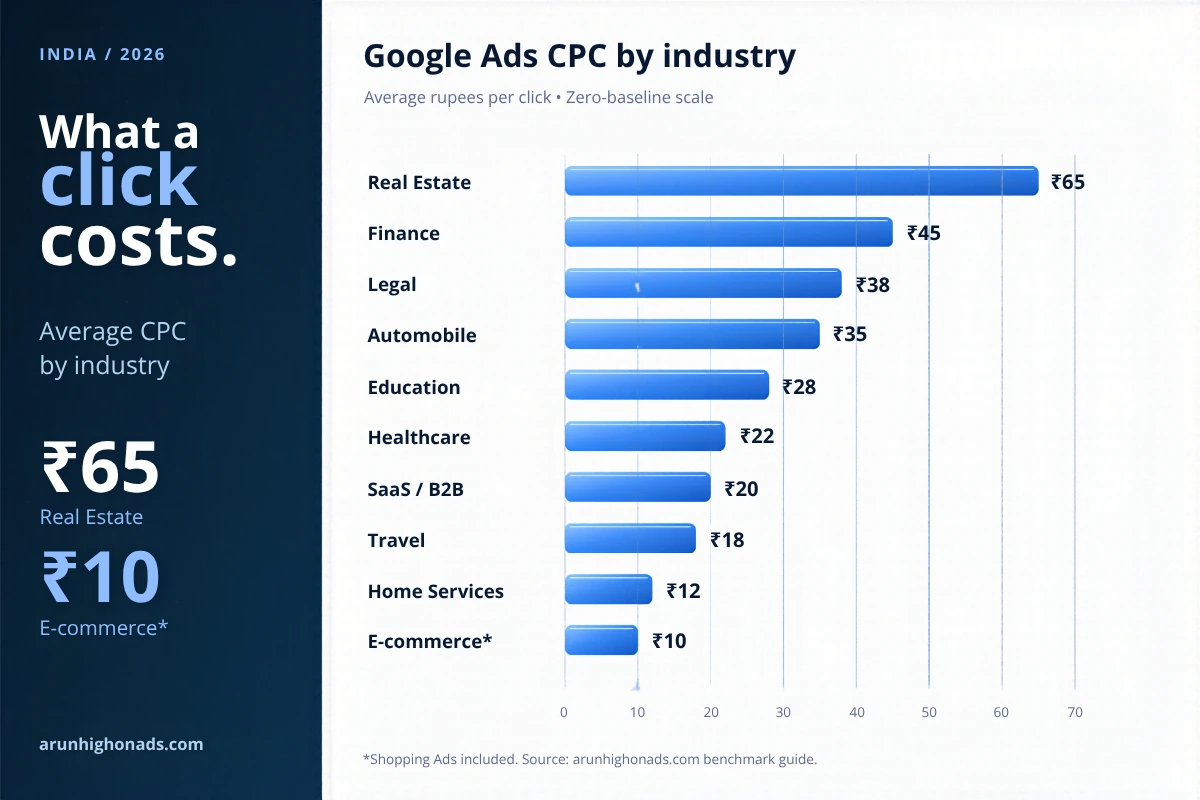
These benchmarks are based on Google Search Ads targeting Indian audiences. Display, YouTube, and Shopping costs are covered separately below.
| Industry | Avg CPC (₹) | Low Range | High Range |
|---|---|---|---|
| Real Estate | ₹65 | ₹40 | ₹120+ |
| Legal Services | ₹38 | ₹20 | ₹75 |
| Finance & Insurance | ₹45 | ₹25 | ₹90 |
| Automobile | ₹35 | ₹18 | ₹70 |
| Education / EdTech | ₹28 | ₹15 | ₹55 |
| Healthcare / Hospitals | ₹22 | ₹12 | ₹45 |
| SaaS / Technology | ₹20 | ₹12 | ₹42 |
| Travel & Tourism | ₹18 | ₹10 | ₹40 |
| Home Services | ₹12 | ₹7 | ₹25 |
| E-commerce (Shopping) | ₹10 | ₹5 | ₹20 |
Sources: OwlClaw PPC Benchmarks India 2026, upGrowth September 2026 estimates, MegaDigital 2026 data.
What this means for you:
Real estate and legal are the most expensive verticals in India; not because clicks are inherently costly, but because customer lifetime value justifies the spend. A single real estate deal can be worth ₹10–50 lakhs in commission. A ₹120 CPC is pocket change.
E-commerce and home services sit at the other end. Lower CPCs, but also lower margins per transaction. Volume matters more here.
The industry average CPC in India is roughly ₹20–₹50 for most businesses. Compare that to the US average of $5.26 (approximately ₹440); India CPCs are 70–85% lower.
Google Ads Cost Per Lead by Industry in India (2026)
CPC tells you what a click costs. CPL tells you what an enquiry costs. A qualified lead and a paying customer are separate outcomes. This is the table that actually matters.
| Industry | Avg CPL (₹) | Good CPL | Excellent CPL |
|---|---|---|---|
| Education (Lead Forms) | ₹150–₹350 | ₹100–₹150 | Under ₹100 |
| Travel & Tourism | ₹200–₹500 | ₹120–₹200 | Under ₹120 |
| Healthcare / Hospitals | ₹300–₹800 | ₹200–₹300 | Under ₹200 |
| E-commerce (Lead Gen) | ₹250–₹600 | ₹150–₹250 | Under ₹150 |
| Finance & Insurance | ₹500–₹1,500 | ₹300–₹500 | Under ₹300 |
| SaaS / B2B Tech | ₹600–₹1,800 | ₹400–₹600 | Under ₹400 |
| Real Estate | ₹800–₹2,000 | ₹500–₹800 | Under ₹500 |
| Enterprise Healthcare | ₹2,500–₹4,000 | ₹1,500–₹2,500 | Under ₹1,500 |
Sources: Sotros Infotech Q1–Q2 2026 (40+ Indian accounts), OwlClaw 2026 benchmarks.
Why the range is so wide:
A ₹200 CPL and a ₹2,000 CPL in the same industry usually come down to three things:
- Landing page conversion rate. A 15% conversion rate vs. a 3% conversion rate is a 5x CPL difference; with identical CPCs.
- Ad relevance and landing-page experience. Quality Score helps diagnose these components; there is no fixed discount attached to a particular score.
- City tier targeting. Tier 1 cities (Mumbai, Delhi, Bangalore) cost 2–3x more per lead than Tier 3 cities.
How City Tiers Affect Google Ads Cost in India
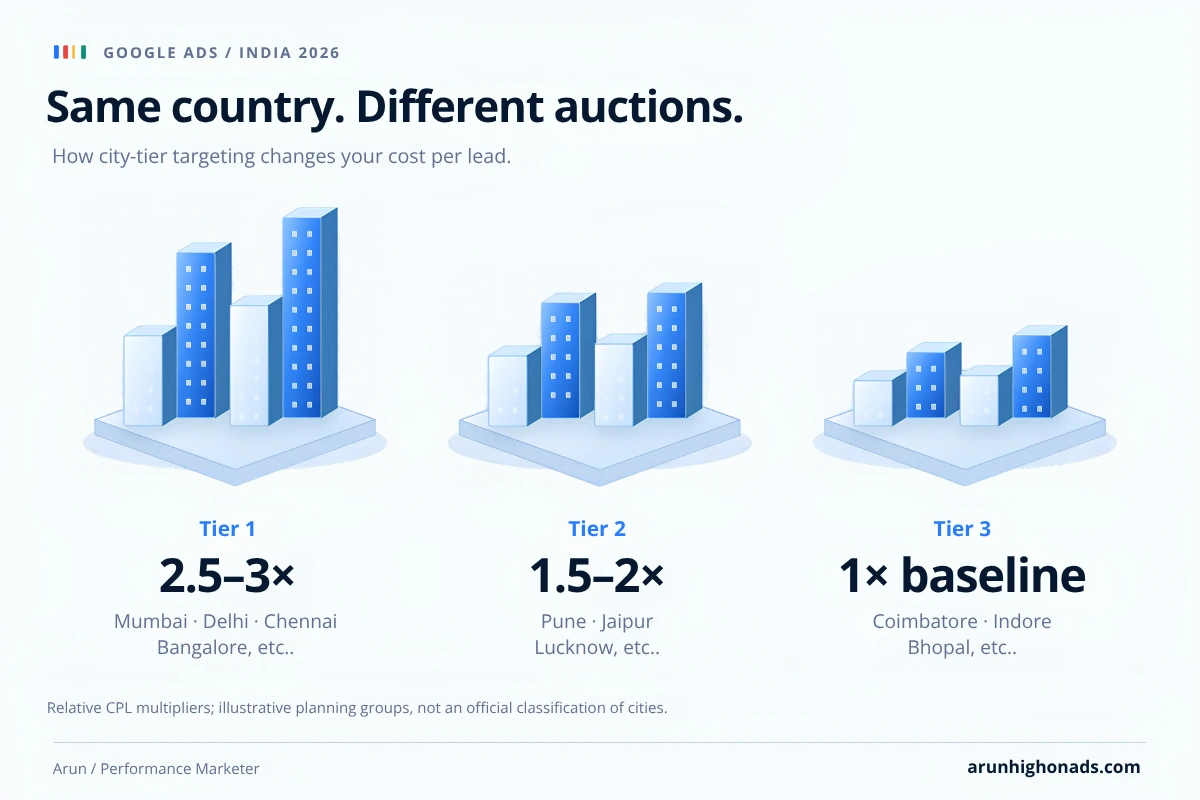
India's city tier system creates three distinct cost environments. This is something most "Google Ads cost" articles completely ignore.
| City Tier | Examples | CPL Multiplier vs Tier 3 | Avg CPC Range |
|---|---|---|---|
| Tier 1 | Mumbai, Delhi, Bangalore, Hyderabad | 2.5–3x | ₹30–₹150+ |
| Tier 2 | Pune, Jaipur, Lucknow, Kochi, Chandigarh | 1.5–2x | ₹15–₹80 |
| Tier 3 | Smaller cities, towns | 1x (baseline) | ₹8–₹40 |
What this means practically:
A real estate developer targeting Bangalore will pay ₹80–₹120 CPC. The same developer targeting Coimbatore might pay ₹25–₹40.
If your business can serve customers in Tier 2/3 cities, you have a structural cost advantage. Many of my clients run separate campaigns for each tier; different budgets, different bid strategies, different CPL targets.
Google Ads Cost by Ad Format in India
Google Ads isn't just Search. Each format has a different cost structure and use case.
Search Ads
- CPC: ₹20–₹150
- CTR: 4.5%–7%
- Best for: High-intent lead generation, service businesses, B2B
- When to use: When someone is actively searching for what you sell
Display Ads
- CPC: ~₹5
- CPM: ~₹50
- Best for: Retargeting, brand awareness, remarketing audiences
- When to use: Nurturing people who've already visited your site
At ₹50 CPM, you get 100,000 impressions for ₹5,000. That's brand awareness at a fraction of what YouTube or TV costs. But display clicks rarely convert directly; use them for retargeting, not cold acquisition.
YouTube / Video Ads
- Cost: ₹1–₹10 per view
- Best for: Brand building, product demos, top-of-funnel awareness
- When to use: When your product needs visual explanation or emotional storytelling
Shopping Ads
- CPC: ₹5–₹15
- Best for: E-commerce product listings
- When to use: When you sell physical products online
Performance Max (PMax)
- CPC: Varies widely (₹10–₹100+)
- Best for: Cross-channel campaigns that Google's AI optimises across Search, Display, YouTube, Gmail, and Maps
- When to use: When you have enough useful conversion data for the selected bidding strategy
Warning on PMax: Performance Max needs useful conversion data, strong assets and appropriate goals. I am cautious with low-volume accounts and small budgets, where focused Search campaigns may give me clearer control and feedback. ₹50K is a planning example, not a platform eligibility threshold.
Quality Score: Diagnose Relevance Before Increasing Spend
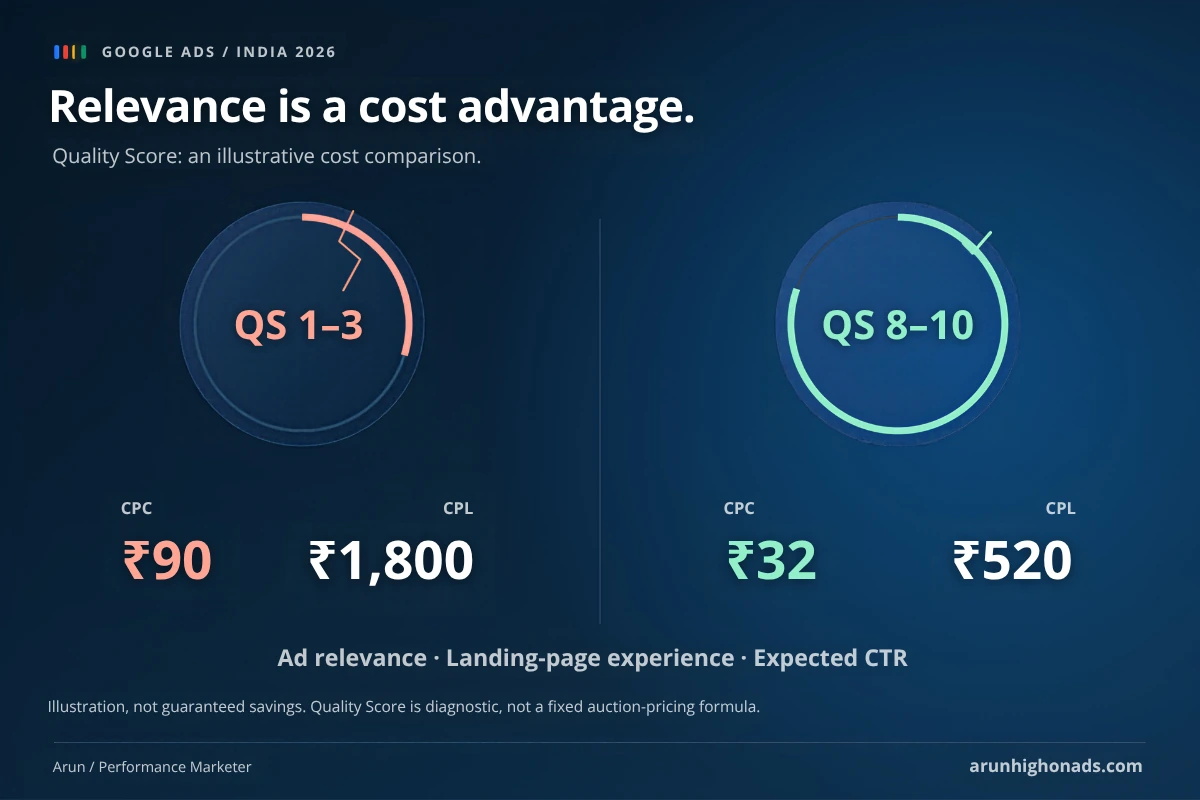
Quality Score is Google's keyword-level diagnostic on a 1–10 scale. It helps identify weaknesses in expected CTR, ad relevance and landing-page experience. The displayed score is not an input in the ad auction and does not create a fixed percentage CPC discount.
The supplied illustration compares QS 1–3 with CPC ₹90 and CPL ₹1,800 against QS 8–10 with CPC ₹32 and CPL ₹520. It illustrates why relevance deserves attention, not a guaranteed before-and-after result or a pricing formula.
Google Ads Help: About Quality Score
How to improve Quality Score:
- Ad relevance. Match the intent and language behind the search. Use relevant keywords naturally and carry the same offer through to the landing page.
- Landing page experience. Fast load time (<3 seconds), mobile-optimised, content that directly answers the search query.
- Expected CTR. Write ads that people actually click. Use specific numbers, benefits, and a clear CTA.
Use the component diagnostics to decide what to improve, then measure actual CPC, conversion rate and qualified CPL. A score change alone does not guarantee savings.
Minimum Budget for Google Ads in India (2026)
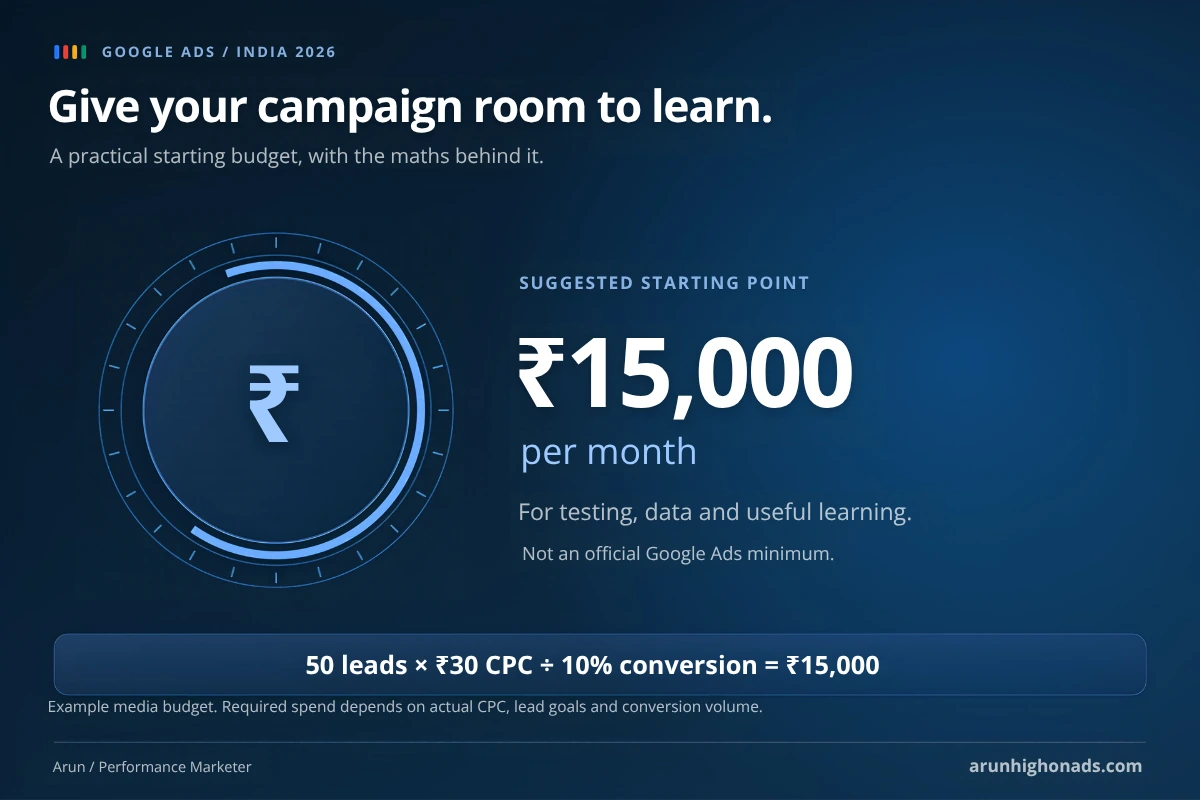
There is no universal monthly minimum for this strategy. The table below is a planning framework; the right budget depends on your CPC, lead goal, conversion rate and learning window.
| Business Type | Monthly Budget (₹) | What You Get |
|---|---|---|
| Local services (salon, clinic, restaurant) | ₹9,000–₹15,000 | 100–300 clicks, 10–30 leads |
| SMB (education, coaching, small e-com) | ₹20,000–₹50,000 | 300–1,000 clicks, 30–100 leads |
| Mid-market (real estate, healthcare chain) | ₹50,000–₹2,00,000 | 1,000–5,000 clicks, 100–500 leads |
| Enterprise (SaaS, multi-location, fintech) | ₹2,00,000+ | 5,000+ clicks, scaled lead gen |
The ₹15,000 rule:
I use ₹15,000/month as a practical starting reference for some local service campaigns, not an official Google minimum. A smaller budget may still work for a tightly defined market, while a competitive or high-ticket campaign may need considerably more.
Choose bidding based on your conversion tracking, objective and available data. Do not assume one monthly spend threshold determines whether Smart Bidding can work.
Budget formula that works:
Monthly Budget = Target Leads × Average CPC × (1 ÷ Landing Page Conversion Rate)Example: You want 50 leads/month. Your industry CPC is ₹30. Your landing page converts at 10%.
Budget = 50 × ₹30 × (1 ÷ 0.10) = ₹15,000Add 18% for GST: ₹17,700/month total.
GST on Google Ads in India: What You Actually Pay
Google's India billing guidance lists 18% IGST, or 9% CGST plus 9% SGST depending on the billing locations. Do not assume every Google Ads purchase falls under reverse charge. Check the legal supplier on your invoice and your payments profile.
For services supplied by Google India Private Limited, Google's guidance says GST is charged on purchases. Enter the correct GSTIN and bill-to details. Whether a particular invoice qualifies for input tax credit depends on your eligibility and documentation.
For a simple planning example, ₹1,00,000 in media spend plus 18% GST is ₹1,18,000 in cash outflow. Do not treat a possible tax credit as automatic cash savings.
Google payments guidance: GST on purchases
Agency fees are separate. Most agencies charge 10–20% of ad spend as management fees. So your total Google Ads cost stack looks like:
| Component | Amount |
|---|---|
| Media spend | ₹1,00,000 |
| GST on media (18% example) | ₹18,000 |
| Agency fee (15% of media) | ₹15,000 |
| GST on agency fee (18%) | ₹2,700 |
| Total monthly cost | ₹1,35,700 |
| Potential ITC (subject to eligibility) | ₹20,700 |
| Illustrative net cost if all ITC is eligible | ₹1,15,000 |
Google Ads vs Facebook Ads: India Cost Comparison (2026)
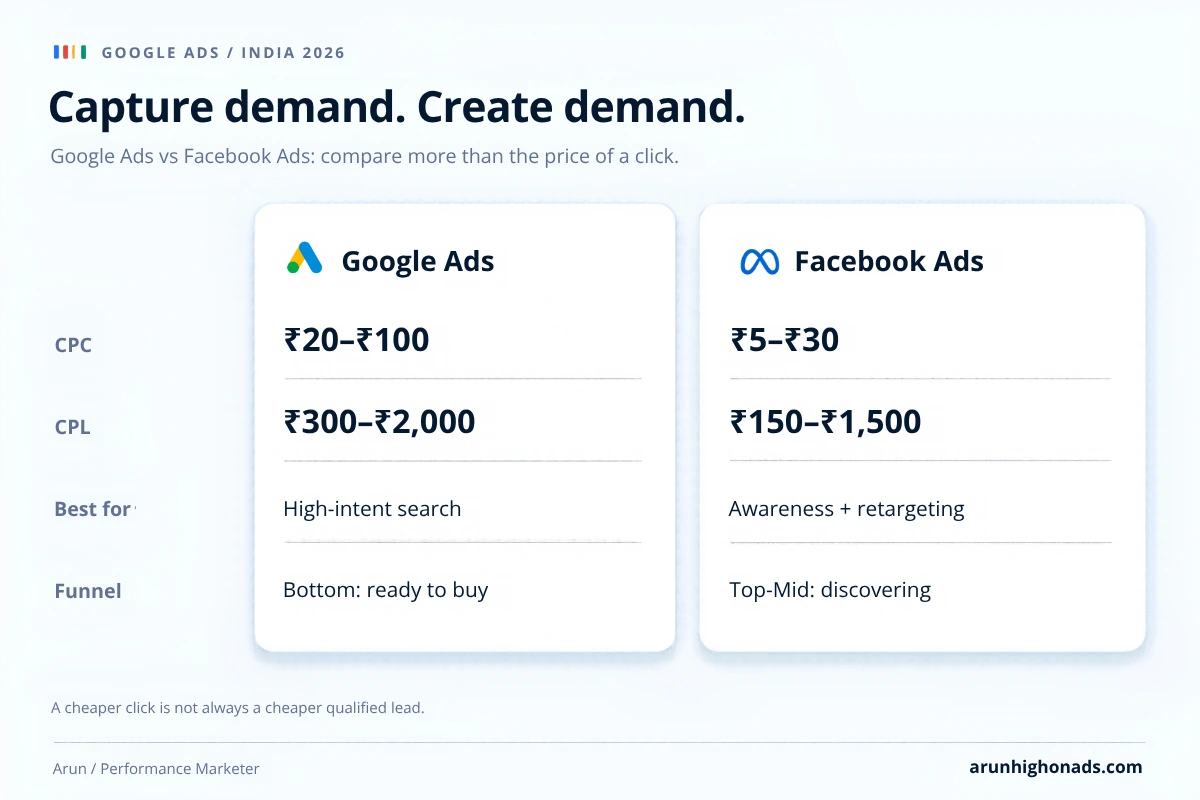
This is the question every business owner asks. Here's the honest answer.
| Metric | Google Ads | Facebook/Meta Ads |
|---|---|---|
| Average CPC (India) | ₹20–₹100 | ₹5–₹30 |
| Average CPM | ₹50 (Display) | ₹50–₹250 |
| Average CPL | ₹200–₹2,000 | ₹150–₹1,500 |
| CTR (Search) | 4.5%–7% | 1.5%–2.0% |
| User Intent | High (actively searching) | Low (passively scrolling) |
| Best For | Capturing existing demand | Creating new demand |
| Lead Quality | Higher (intent-based) | Lower (interest-based) |
| Minimum Viable Budget | ₹15,000/month | ₹10,000/month |
The real comparison isn't CPC; it's cost per qualified lead.
Google clicks cost more, but they convert better because the user is actively searching for your product. Facebook clicks are cheaper, but many of those clicks are curiosity clicks, not purchase-intent clicks.
When to use Google:
- Someone is searching "best orthodontist in Chennai"; that's Google
- High-ticket services (real estate, legal, B2B SaaS) where intent matters
- When you need leads who are ready to buy, not just interested
When to use Facebook:
- You're launching something new that people don't search for yet
- Visual products (fashion, food, home decor) where scroll-stopping creative drives purchases
- Retargeting Google visitors who didn't convert
- Budget is under ₹15K/month (Facebook's algorithm learns faster on small budgets)
When to use both:
- Facebook for top-of-funnel awareness Google Search for bottom-of-funnel conversion
- Measure blended qualified CPL across the channels before scaling the mix. A combined strategy is not automatically cheaper.
India vs Global: How Cheap Are Indian Google Ads Really?
| Metric | India (2026) | US (2026) | India Savings |
|---|---|---|---|
| Average Search CPC | ₹20–₹50 | $5.26 (~₹440) | 70–85% cheaper |
| Average CTR | 4.5%–7% | 6.64% | Comparable |
| Average CVR | 5%–12% | 7.52%–8.18% | Comparable |
| Average CPL | ₹200–₹800 | $66.69–$70.11 (~₹5,500) | 75–85% cheaper |
| Legal CPC | ₹38 | $8.58 (~₹715) | 95% cheaper |
| Real Estate CPC | ₹65 | $3.22 (~₹270) | 76% cheaper |
Sources: LocaliQ/WordStream 2026, DesignRush 2026, SearchEngineJournal 2026, OwlClaw 2026.
Why India is so much cheaper:
- Lower auction competition. Fewer advertisers bidding on keywords
- Purchasing power parity. Lower revenue per customer = lower bid ceilings
- Market maturity. US Google Ads has had 20+ years of advertiser adoption. India is still early
But this is changing. Global CPC climbed ~13% year-over-year in 2025, with 87% of industries seeing increases. India is following the same trajectory. The window of cheap Google Ads in India is narrowing.
7 Ways to Reduce Google Ads Cost in India
1. Fix Your Quality Score First
Audit expected CTR, ad relevance and landing-page experience before increasing budget. Use Quality Score as a diagnostic, then assess measured CPC and conversion outcomes.
2. Choose Match Types for Your Data and Control Needs
Broad match keywords in India generate massive irrelevant traffic. "Best school in Delhi" on broad match will trigger ads for "best cricket academy" and "school uniform shop." Use exact and phrase match when tighter control is useful. Test broad match only when conversion measurement and bidding are appropriate for the account.
3. Build a Relevant Negative Keyword List
In India specifically, add negative keywords for:
- "Free" / "मुफ्त" (Hindi)
- "Jobs" / "vacancy" / "salary" / "career"
- "Wikipedia" / "meaning" / "full form"
- Competitor brand names (unless you're running conquest campaigns)
- "Download" / "PDF"
4. Daypart Your Campaigns
Use your own qualified conversion data to decide schedules. Business-hour campaigns may suit some B2B accounts; do not exclude evening or weekend demand without checking the results.
5. Separate Campaigns by City Tier
Don't mix Mumbai and Madurai in the same campaign. Tier 1 cities need higher bids and tighter targeting. Tier 3 cities can run on lower CPCs with broader keywords.
6. Landing Page Speed Kills CPL
Slow landing pages can lose enquiries, especially on mobile. Prioritize fast-loading pages, compressed responsive images, minimal blocking JavaScript and a clear conversion path. Measure your actual loading performance and conversion rate.
7. Track Qualified Leads, Not All Leads
If your Google Ads dashboard shows 100 leads at ₹200 CPL but only 20 are qualified, your real CPL is ₹1,000. Set up offline conversion tracking to feed qualified lead data back to Google's algorithm.
When NOT to Use Google Ads in India
Google Ads isn't always the answer. Here's when to skip it:
1. No one is searching for what you sell. If you've invented a new product category, there's zero search volume. Use Facebook/Instagram to create demand first, then capture it with Google later.
2. Your budget is under ₹10,000/month. At this level, you'll get 50–200 clicks. That's not enough data for meaningful optimisation. Invest in SEO or social media content instead.
3. Your landing page converts below 3%. Sending paid traffic to a page that doesn't convert is literally burning money. Fix the page first, then turn on ads.
4. You can't track conversions. If you don't have conversion tracking set up; form submissions, phone calls, WhatsApp clicks; you're flying blind. Set up tracking before spending a single rupee.
5. Your margins can't support the CPL. If your average order value is ₹500 and your CPL is ₹400, the math doesn't work. Focus on higher-margin products or reduce CPL through CRO before scaling ads.
₹50,000/Month Google Ads Campaign Blueprint
Here's exactly how I'd structure a ₹50K/month Google Ads campaign for a service business in India:
Campaign Split:
| Campaign | Budget | Purpose |
|---|---|---|
| Search; High Intent | ₹30,000 (60%) | Bottom-funnel keywords ("buy," "near me," "price," "book") |
| Search; Mid Intent | ₹12,000 (24%) | Research keywords ("best," "top," "vs," "review") |
| Remarketing; Display | ₹5,000 (10%) | Retarget website visitors who didn't convert |
| Brand Defence | ₹3,000 (6%) | Bid on your own brand name to block competitors |
Illustrative targets, not a delivery forecast:
- Total clicks: 1,000–2,500 (depending on CPC)
- Leads: 70–200
- CPL: ₹250–₹700
- Minimum ROAS target: 5:1
Week-by-Week Optimisation:
- Week 1: Launch, collect data, add negative keywords daily
- Week 2: Pause keywords with <3% CTR, test 2 new ad variations
- Week 3: Shift budget from mid-intent to high-intent if CPL allows
- Week 4: Analyse search term report, expand negative keywords, assess Quality Scores
The AI Factor: How Google's AI Is Changing Costs in 2026
Google's AI-powered features; AI Overviews, Gemini in Search, conversational ads; are reshaping the cost landscape.
What's happening:
- AI Overviews are answering more queries directly in search results, reducing organic clicks
- This pushes more businesses toward paid ads, increasing auction competition
- The impact on paid campaign costs varies by query and market; do not assume an AI Overview creates a predictable CPL increase
- Smart Bidding algorithms are getting better but need more conversion data to outperform manual bidding
What to do about it:
- Invest in first-party conversion data (offline conversion tracking, CRM integration)
- Focus on long-tail, high-intent keywords that AI Overviews don't fully answer
- Build landing pages that convert at 10%+ to absorb rising CPCs
- Consider running ads on query types where AI Overviews actually increase ad visibility (commercial queries)
FAQ: Google Ads Cost in India
What is the average CPC for Google Ads in India?
The average CPC for Google Search Ads in India ranges from ₹20 to ₹150, with most industries falling between ₹20 and ₹50. Display ads cost approximately ₹5 CPC or ₹50 CPM.
What is the minimum budget for Google Ads in India?
There is no universal monthly minimum. The planning framework starts around ₹9,000–₹15,000/month for local services and ₹20,000–₹50,000/month for SMBs. The useful budget depends on your CPC, goal, conversion rate and learning window; ₹15,000 is not a Smart Bidding eligibility rule.
Is Google Ads cheaper than Facebook Ads in India?
No. Google Ads CPC (₹20–₹100) is typically higher than Facebook Ads CPC (₹5–₹30). However, Google Ads often delivers higher-quality leads because users have active purchase intent, resulting in comparable or lower cost per qualified lead.
Does GST apply on Google Ads in India?
Google's India guidance lists 18% IGST or 9% CGST plus 9% SGST. Check your supplier and invoice instead of assuming reverse charge. GST can be charged by Google, and input tax credit depends on eligibility and documentation.
How do I reduce my Google Ads CPC?
Improve relevance and landing-page experience, choose match types suited to your data, maintain relevant negative keywords, separate markets when useful and track qualified lead outcomes. Quality Score diagnoses issues; it does not provide a fixed CPC discount.
What Quality Score should I aim for?
Review the expected CTR, ad relevance and landing-page experience diagnostics. The displayed 1–10 score can point to issues, but no particular score guarantees a CPC or CPL saving.
Is Google Ads worth it for small businesses in India?
It can be worthwhile when there is relevant search demand, reliable conversion tracking and enough margin to support qualified CPL. Use the budget examples as planning references, not a fixed eligibility threshold.
Need Help Running Profitable Google Ads in India?
Irrelevant clicks, weak landing pages and incomplete tracking can waste a campaign budget. Start by finding where the qualified enquiries are being lost.
I've managed ₹8 Cr+ in ad spend across Google, Meta, and LinkedIn; generating 2,500+ qualified leads for businesses in real estate, education, healthcare, SaaS, and e-commerce.
If your Google Ads CPL is too high, your Quality Score is below 7, or you're not sure if your campaigns are structured correctly; let's fix that.
Written by Arun; Performance Marketer & Founder at Pixel Buzz. I write about what actually works in paid media, not what sounds good in theory.
Data sources: OwlClaw PPC Benchmarks India 2026, upGrowth September 2026 estimates, Sotros Infotech Q1–Q2 2026 (40+ accounts), MegaDigital 2026, WordStream/LocaliQ 2026, SearchEngineJournal 2026, WebFX 2026, TheMediaAnt 2026, Exchange4Media 2026, MayankDigitalLabs 2026.

Arun Prasath
Performance Marketer and Founder, Pixel Buzz, based in Chennai. I connect paid media, creative, landing pages and lead qualification for businesses in India and the UAE.
How I approach the work
Sources & benchmark notes
The supplied article names OwlClaw, upGrowth, Sotros Infotech, MegaDigital, LocaliQ / WordStream and other publications. Its numeric tables remain author-supplied planning data: no underlying account cohort, attribution window or independently audited national dataset was provided.
- Google Ads Help: About Quality Score. The displayed score is diagnostic, not an auction input.
- Google payments guidance: GST on purchases. Check supplier, invoice and payments-profile details.
- Campaign case studies provide project-specific context.
Published 26 November 2026. Planning examples do not guarantee spend, delivery or qualified leads.